
The Best Power Bank for Every Need in 2026
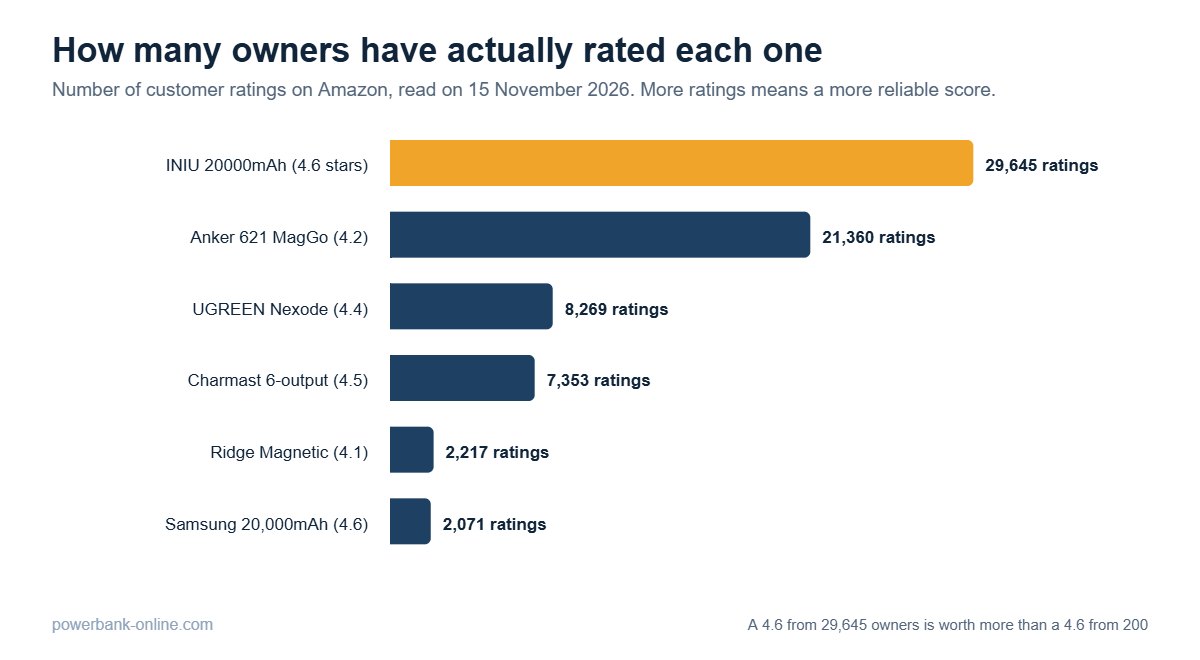
The best power bank for most people is the INIU 20000mAh 22.5W, because it carries two full phone charges, puts out enough watts to fast charge, and has been rated by nearly thirty thousand owners. If you need to charge a laptop instead, the UGREEN Nexode 145W is the one to buy.
Power Bank Online is reader funded. If you buy through a link on this page we may earn a commission at no extra cost to you. It never changes what we recommend. Full disclosure.
We looked at the power banks people are actually buying right now, kept only the ones rated 4.0 stars or better by at least 200 owners, and compared them on the three things that decide whether you will be happy with one: how much charge you really get, how fast it delivers it, and how much you have to carry.
You will not find a price anywhere on this page. Prices move daily and a stale price is worse than none at all. Check the current price at Amazon, where it is always right.
The best power bank for each need
Best overall
INIU 20000mAh 22.5WTwo full phone charges, fast enough, and the most owner feedback of anything here.
Best for laptops
UGREEN Nexode 145WThe only one here with enough watts to properly charge a laptop.
Fastest for phones
Samsung 20,000mAh 45WTwice the output of the usual 22.5W banks, in a known brand.
If you forget cables
Charmast 20000mAh 6-outputThree cables built into the body. Nothing to leave behind.
Best magnetic
Ridge 20W MagneticSnaps onto the back of a compatible phone, with cables built in too.
Smallest
Anker 621 MagGoPocket sized top up. Honest about what it delivers.
Power banks compared
| Model | Capacity | Max output | Ports | Weight | Owner rating | Score |
|---|---|---|---|---|---|---|
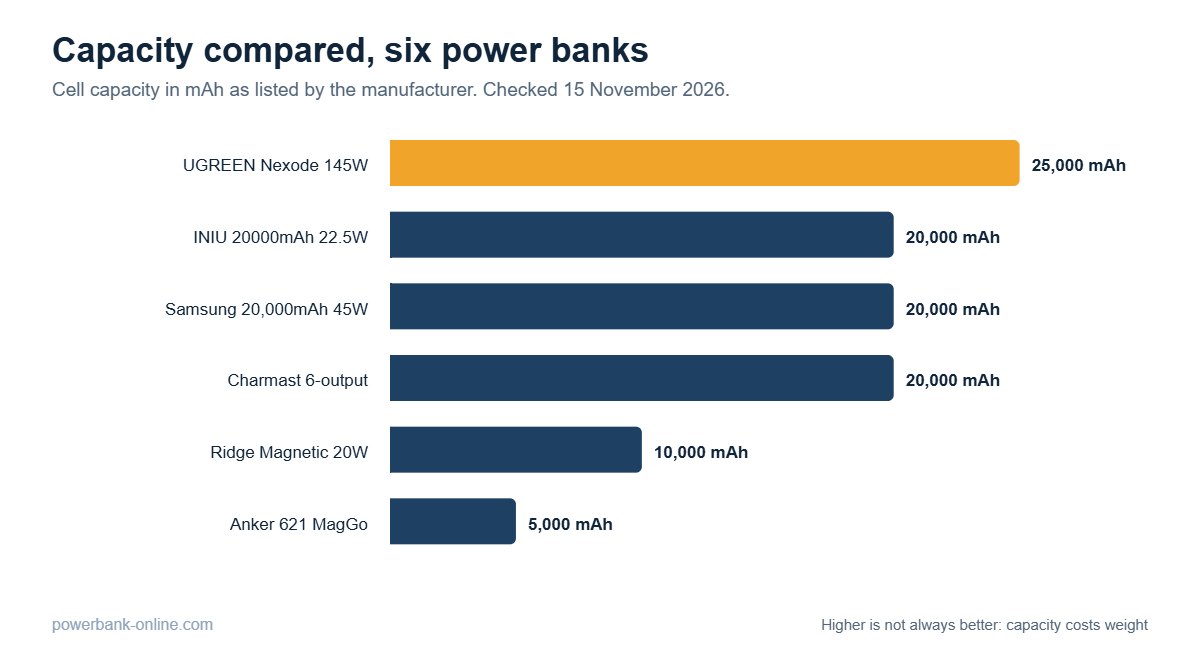
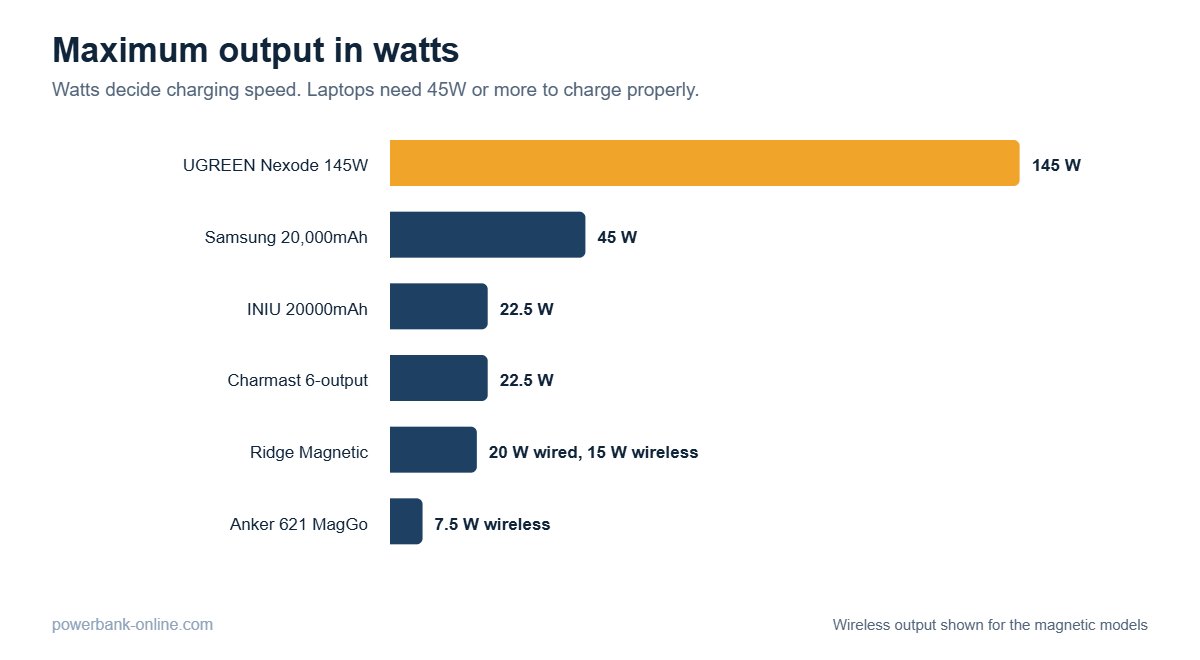
| INIU 20000mAh 22.5W | 20,000 mAh | 22.5 W | 1 USB-C in/out, 2 USB-A | Not listed | 4.6 from 29,645 | 4.2 |
| UGREEN Nexode 145W | 25,000 mAh | 145 W | 2 USB-C, 1 USB-A | 2.23 lb as listed | 4.4 from 8,269 | 4.8 |
| Samsung 20,000mAh 45W | 20,000 mAh | 45 W | 3 ports, USB-C | 12.3 oz | 4.6 from 2,071 | 4.4 |
| Charmast 20000mAh 6-output | 20,000 mAh | 22.5 W | 1 USB-C, 2 USB-A, 3 built-in cables | Not listed | 4.5 from 7,353 | 4.2 |
| Ridge 20W Magnetic | 10,000 mAh | 20 W wired, 15 W wireless | USB-C, Lightning, wireless | 6.3 oz | 4.1 from 2,217 | 3.7 |
| Anker 621 MagGo | 5,000 mAh | 7.5 W wireless | 1 USB-C, wireless | 9.9 oz for the two pack | 4.2 from 21,360 | 3.2 |
Weights are quoted exactly as the Amazon listing states them on the check date. Where a manufacturer does not publish a weight, we say so rather than guess.
1. INIU 20000mAh 22.5W, the best power bank for most people
Score 4.2 out of 5 | It does the ordinary job better than anything else here, and more owners have confirmed it than for any other model on this page.
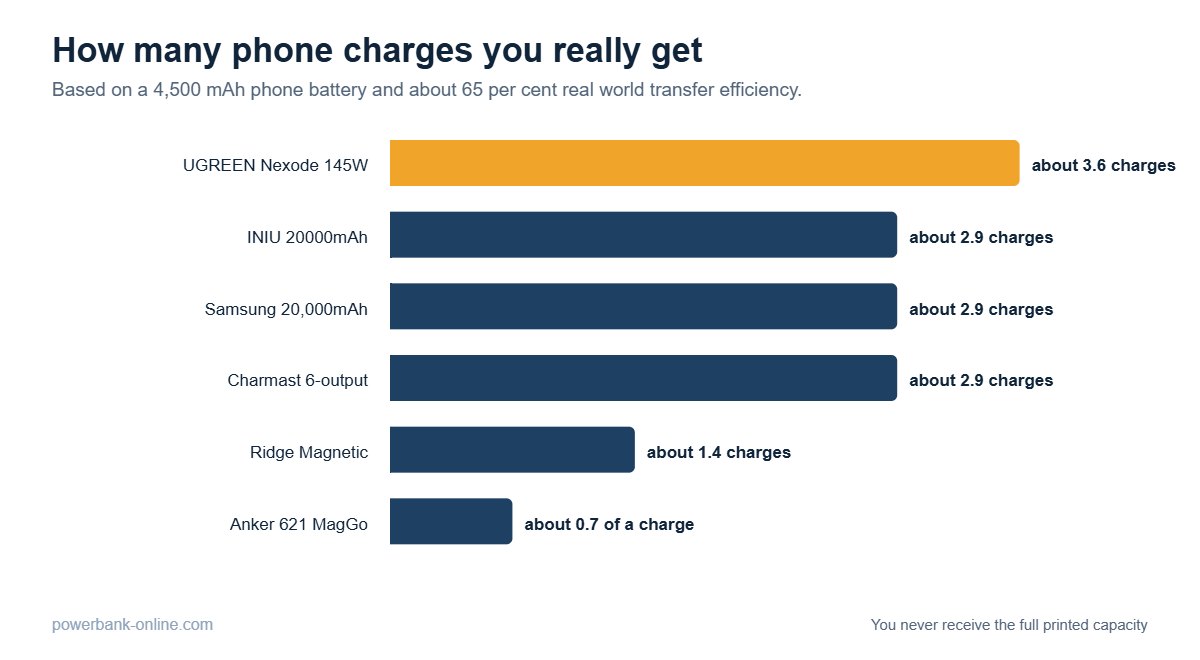
This is the one to buy if you are not sure what you need. Twenty thousand milliamp hours is the capacity that suits most people: around two and a half to three full phone charges in practice, enough for a weekend away or a long travel day, without the weight of a 25,000 mAh brick.
The 22.5W USB-C port is fast enough to matter. It will take a modern phone from flat to roughly half in about half an hour, and the same port recharges the bank itself. Two extra USB-A outputs mean you can keep a friend’s phone and a pair of earbuds alive at the same time.
INIU publishes its own charge cycle figures rather than hiding behind the headline number, which we like: 3.4 charges for an iPhone 16, 3 for a Galaxy S24. The three year warranty is longer than most brands at this level offer.
What owners say: the recurring praise is that it holds charge for weeks when left in a bag, and that the LED percentage display is genuinely readable. The recurring complaint is size, several owners expecting something pocketable and finding a bank that needs a bag.
Pros
- Nearly 30,000 owner ratings at 4.6 stars, by far the most evidence here
- Three year warranty
- Manufacturer publishes honest charge cycle figures
- Three outputs, so it covers a group
Cons
- Too big for a pocket, despite the word compact in the name
- 22.5W is fine for phones but nowhere near enough for a laptop
- No weight published
Buy it if you want one power bank that handles phones, tablets and a few days away without thinking about it. Skip it if you need to charge a laptop, or you want something that lives in a jacket pocket.
2. UGREEN Nexode 145W, the best power bank for a laptop
Score 4.8 out of 5 | The highest capability score on this page, and the only model here that can genuinely charge a laptop.
Laptops change the maths. A laptop battery is typically 50 to 80 watt hours, and it needs power delivered quickly, not just stored. Below about 45W most laptops charge so slowly that working on them drains the battery faster than the bank refills it.
At 145W across three ports, this is the only model here that clears that bar with room to spare. It will run a mainstream laptop while you use it, and still have output left for a phone on the side. The 25,000 mAh cell holds roughly one full laptop charge, or close to four phone charges.
The trade off is weight. Amazon lists it at 2.23 pounds and it measures 6.3 by 3.2 by 1.1 inches, which is a brick in anybody’s language. This is a bank you pack deliberately, not one you carry by habit.
What owners say: praise concentrates on it actually delivering the advertised wattage under load, which is not a given in this category. The complaints are weight, and that it gets noticeably warm when pushing full output.
Pros
- 145W is enough for almost any laptop
- Largest capacity here at 25,000 mAh
- Two USB-C ports plus a USB-A
- Still under the 100 Wh airline limit at 92.5 Wh
Cons
- Much heavier than everything else on this page
- Runs warm at full output
- Overkill, and overweight, if you only charge a phone
Buy it if you need to keep a laptop alive away from a socket. Skip it if your heaviest device is a tablet, because you are paying for watts and carrying weight you will never use.
3. Samsung 20,000mAh 45W, the fastest for phones
Score 4.4 out of 5 | Double the output of the usual 22.5W bank, with the same capacity and a brand that stands behind it.
Most 20,000 mAh banks settle at 22.5W. This one puts out 45W, which is the figure that matters if you own a recent Samsung phone or a tablet, because it unlocks the faster charging those devices support rather than throttling them to a trickle.
The practical difference is real but easy to overstate. On a phone that supports it you will notice the first thirty minutes clearly. On a phone that does not, you are carrying headroom you cannot use.
At 12.3 ounces it is one of the few here with a published weight, and it is reasonable for the capacity. Three ports means it can serve more than one device, and it recharges itself quickly over USB-C.
What owners say: the strong praise is build quality and that it charges Samsung tablets at full speed, which cheaper banks do not. The repeated complaint is that it has the fewest owner ratings of anything on this page, so there is less long term evidence than for the INIU, and a handful of owners report it being fussy about third party cables.
Pros
- 45W output, double the usual at this capacity
- Published weight of 12.3 oz, sensible for 20,000 mAh
- Three ports
- Major brand with a real support route
Cons
- Only 2,071 ratings, the least evidence here
- The 45W advantage is wasted on phones that cannot use it
- Some owners report cable fussiness
Buy it if you own a recent Samsung phone or tablet and want the fastest charge it can take. Skip it if your devices top out at 20W, because the INIU does the same job on more evidence.
4. Charmast 20000mAh 6-output, for people who forget cables
Score 4.2 out of 5 | The same capability as the INIU, with the single feature that solves the most common real world failure.
The most common reason a power bank fails you is not capacity. It is that the cable is at home. This one has three cables built into the body, plus a USB-C and two USB-A ports, so it can charge up to six things and you cannot leave the cable behind.
Everything else is familiar territory: 20,000 mAh, 22.5W, an LED percentage readout. In charging terms it behaves almost identically to the INIU, which is the point. You are choosing it for the cables, not the electronics.
The compromise is that built-in cables are the part most likely to fail, and when one does you cannot replace it. A loose integrated cable turns the whole bank into a lesser product.
What owners say: the praise is almost entirely about convenience, people describing it as the bank they actually grab because it needs no preparation. The complaints cluster on the built-in cables being short, and a minority reporting one cable failing after heavy use.
Pros
- Three cables built in, nothing to forget
- Six outputs, enough for a family at an airport
- Same 20,000 mAh and 22.5W as the top pick
- 7,353 ratings at 4.5 stars
Cons
- Built-in cables are short and cannot be replaced
- A failed cable cannot be swapped out
- No weight published
Buy it if you have been caught out by a missing cable more than once. Skip it if you always carry your own cables, because then you are accepting a failure point for nothing.
5. Ridge 20W Magnetic, the best magnetic power bank
Score 3.7 out of 5 | Lower on raw capability, higher on the thing magnetic buyers actually want, which is not having to think about cables at all.
A magnetic bank snaps onto the back of a compatible phone and charges it wirelessly while you carry both as one object. The appeal is genuine: no cable, no second thing in your pocket, no trailing wire while you walk.
This one is unusual in the category because it does not force you to choose. It charges wirelessly at 15W, has a 20W wired USB-C output, and carries built-in USB-C and Lightning cables as well. At 6.3 ounces it is the lightest full featured bank here.
Be clear eyed about the physics. Wireless charging wastes a meaningful amount of energy as heat, so a 10,000 mAh magnetic bank delivers noticeably fewer charges wirelessly than the same capacity would over a cable. You are paying capacity for convenience.
What owners say: praise focuses on the magnet being strong enough to hold through a pocket, which is the whole product working. The 4.1 rating is the lowest here, and the complaints cluster on the magnet weakening with cases and on the bank running warm while charging wirelessly.
Pros
- Wireless, wired and built-in cables in one device
- Lightest full featured bank here at 6.3 oz
- Charges up to four devices at once
- Only 37 Wh, comfortably flight legal
Cons
- Lowest owner rating on this page at 4.1
- Wireless charging wastes energy as heat
- Magnet strength depends on your case
Buy it if you want to stop carrying cables and own a phone that supports magnetic attachment. Skip it if you want maximum charges per gram, because wired is always more efficient.
6. Anker 621 MagGo, the smallest
Score 3.2 out of 5 | The lowest capability score here, and still the right answer for a particular kind of person.
At 5,000 mAh this is a top up, not a charge. Anker is refreshingly honest about it and publishes an effective output of 2,750 to 3,250 mAh, which is roughly 65 per cent of the printed figure. That is the real world efficiency we describe throughout this site, confirmed by the manufacturer in writing.
In practice that means around 70 per cent of a modern phone battery, or a full charge of an older or smaller phone. Anker lists 73 per cent for an iPhone 17 and 62 per cent for an iPhone 17 Pro Max.
What you get in exchange is size. It attaches magnetically, disappears behind the phone, and is the only model here you would genuinely carry without noticing. Wireless output is 7.5W, which is slow, and that is the honest cost of the form factor.
What owners say: 21,360 ratings is the second largest sample here, and the 4.2 average reflects a split. People who bought it expecting a top up are happy. People who expected a full charge are not, and that is an expectation problem rather than a product fault.
Pros
- Genuinely pocketable
- Manufacturer publishes honest effective output figures
- 21,360 owner ratings
- Only 18.5 Wh, no airline question at all
Cons
- Less than one full phone charge
- 7.5W wireless output is slow
- This listing is sold as a two pack
Buy it if you want insurance against a flat battery on the way home, in something that fits a jacket pocket. Skip it if you need a charge rather than a top up.
How to choose a power bank
Capacity is not what you think it is
The mAh figure on the box is the capacity of the cells inside, not the amount that reaches your phone. Converting the battery’s voltage to the 5V your phone wants costs energy, and so does heat. You receive roughly 60 to 70 per cent of the printed number.
You do not have to take our word for it. Anker publishes an effective output of 2,750 to 3,250 mAh for its 5,000 mAh bank, which is 55 to 65 per cent. Every brand loses the same way; most just do not print it.
Watts decide speed, and laptops are a different problem
A 5W output will take most of a night to fill a modern phone. An 18 to 22.5W USB-C port reaches half charge in about half an hour. For laptops you need 45W as a minimum, 65W for most mainstream machines, and 100W or more for larger ones.
Weight is the factor people regret ignoring
A 20,000 mAh bank weighs somewhere around 350 to 400 grams. The 25,000 mAh laptop bank here is listed at over a kilogram. A power bank you left at home because it was heavy has no capacity at all.
Ports, and the trap of shared output
USB-C with Power Delivery is the port that matters. Watch for shared wattage: many banks advertise a high total output that drops sharply the moment a second device is plugged in.
Will it get through airport security?
Airlines measure power banks in watt hours, not mAh. Multiply the capacity in mAh by 3.7, then divide by 1,000. Anything under 100 Wh goes in carry-on without asking. Between 100 and 160 Wh you normally need the airline’s approval in advance. Above 160 Wh it will usually be refused.
Every power bank on this page is under the 100 Wh limit, including the 25,000 mAh laptop model at 92.5 Wh. That is not an accident: 26,800 mAh, which works out at 99.2 Wh, is the largest capacity that clears the limit, which is why that odd number appears on so many travel models.
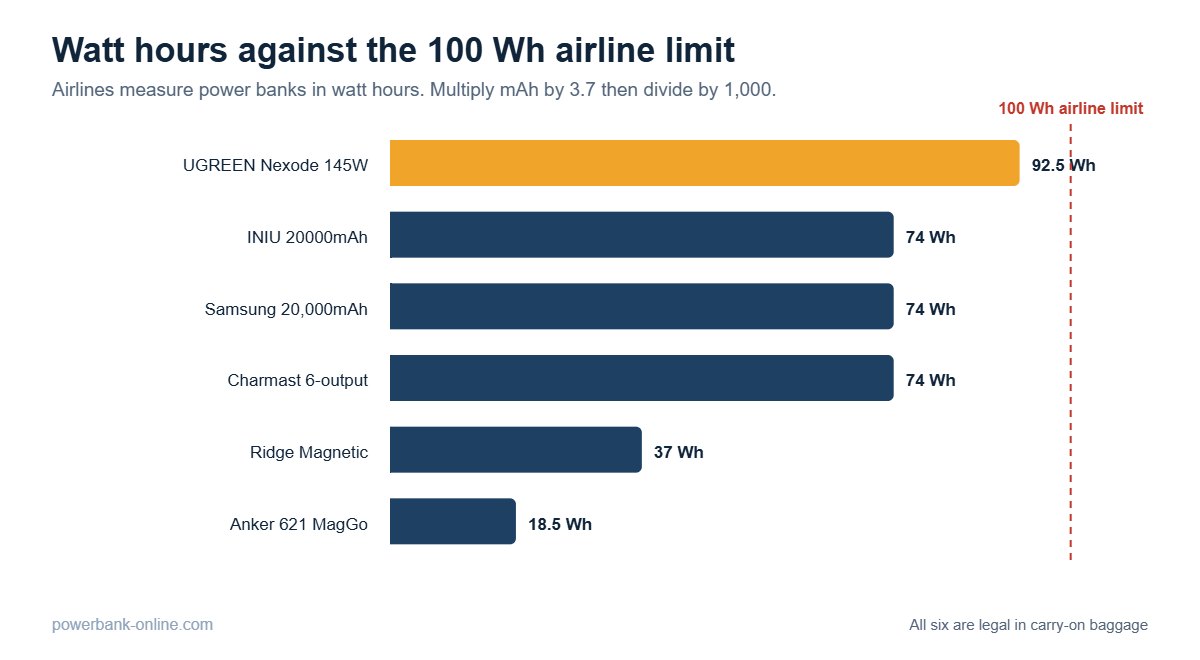
Three rules apply whatever the size. A power bank travels in your cabin bag, never in checked luggage. Keep the terminals covered or the bank in its own pocket. And rules vary by carrier and country, so confirm with your airline rather than trusting any general guide, including this one.
How we score and choose
Our picks are based on manufacturer specifications, independent lab and hands-on reviews, and thousands of customer reviews. We have not physically tested these six, and we do not pretend otherwise. Where we handle a product ourselves we say so on that product and show our own photographs.
Nothing appears on this page unless it is in stock, rated at least 4.0 stars, and has at least 200 owner ratings.
What the score measures
Each score is the average of three things we can check for every product, each marked out of 5:
- Power. Maximum output in watts. 100W or more scores 5.0, 60 to 99W scores 4.5, 40 to 59W scores 4.0, 20 to 39W scores 3.5, below 20W scores 3.0.
- Capacity. 25,000 mAh and above scores 5.0, 20,000 to 24,999 scores 4.5, 10,000 to 19,999 scores 3.5, 5,000 to 9,999 scores 2.5.
- Owner rating. The Amazon star rating on the date we checked, used as it stands.
We do not score weight or warranty, because not every manufacturer publishes them and a score built on missing data is worse than no score. Both are reported in the table where they exist.
The score measures capability, not suitability. That is why the heaviest, most powerful bank here scores highest and is still the wrong choice for most people. A laptop charger that outscores everything is of no use to someone charging a phone. Read the score as what a product can do, and the need headings as who should buy it.
Common questions
What power bank do I need?
Take your phone’s battery capacity and double it. For most modern phones that lands between 8,000 and 10,000 mAh, which gives you a full charge in hand with room to spare. Step up to 20,000 mAh only if you are charging more than one device or will be away from a socket for more than a day, and to 25,000 mAh with high wattage only if a laptop is involved.
How many mAh is a good power bank?
For a phone, 10,000 mAh is where capacity and weight balance best, and 20,000 mAh is the sweet spot for travel. Below 5,000 mAh you are buying a top up rather than a charge. Above 25,000 mAh you are mainly buying weight unless you have a laptop to keep alive, and you start running into airline limits.
What does mAh actually mean on a power bank?
mAh means milliamp hours, a measure of how much charge the cells inside can hold. It is not the amount that reaches your device. After voltage conversion and heat losses you should expect roughly 60 to 70 per cent of the printed number to arrive in your phone. Anker publishes 2,750 to 3,250 mAh of effective output for its 5,000 mAh bank, which confirms the figure.
How long does a 5,000 mAh power bank last?
A 5,000 mAh bank delivers around 3,000 to 3,250 mAh in practice, which is roughly 70 per cent of a modern phone battery or a full charge of an older one. Left unused in a drawer, a good power bank holds most of its charge for several months.
Does a new power bank come charged?
Most arrive partly charged, usually between 30 and 60 per cent, because shipping rules limit how full a lithium battery may be in transit. Charge it fully before the first proper use, and do not be alarmed if that first charge takes longer than later ones.
How long does a power bank take to charge?
It depends far more on the input rating than on the capacity. A 20,000 mAh bank charging over old micro USB at 5W can take most of a day. The same bank over USB-C Power Delivery at 22.5W is usually done in four to five hours. Always check the input rating, not just the output.
Can I take these power banks on a plane?
Yes. All six are under the 100 watt hour limit, so they travel in your carry-on bag with no approval needed. They must never go in checked luggage. Confirm the current rules with your specific airline before you fly, because they vary by carrier and country.
Why you can trust this guide
What we did. We read the manufacturer’s specification for every product here and checked the figures against the retailer listing on 15 November 2026. We read owner reviews in volume, looking for complaints that repeat after months of ownership rather than first week frustration. We rejected every product that fell below 4.0 stars or 200 ratings, including two well known brands that did not clear the bar.
What we did not do. We did not physically test these six, and we have not pretended to. We did not invent an author. We did not publish a price. And we have told you where a manufacturer declines to publish a weight rather than filling the gap with a guess.
How we earn. If you buy through a link here we may earn a commission from the retailer at no extra cost to you. Commission plays no part in what we recommend or how we rank it. The model that scores highest on this page is not the one we tell most readers to buy.
About this guide
Power Bank Online Editorial Team. Publishing independent portable power reviews since 2017. Our guides are produced by the editorial team rather than credited to a single named reviewer, because the research behind them is genuinely shared work. Read more about how we research and choose products.
Last updated 15 November 2026.
Related guides
- Best power bank for mobiles
- Best 20,000 mAh power banks
- Power bank for laptop
- 10,000 mAh power bank reviews
- High capacity power banks
- What is a power bank
- Power bank safety
As an Amazon Associate we earn from qualifying purchases. Specifications and owner ratings were read from Amazon listings on 15 November 2026 and may have changed since. Airline rules vary by carrier and country, so always confirm with your airline before you travel.