

Organizations don’t recommend trying to jump a motorcycle with a car. The reason is that car batteries are a lot bigger and have a lot higher amperage & can harm a motorcycle battery. Life doesn’t generally coordinate, be that as it may, and you may end up with a minimal option. Fortunately, with appropriate precautions, you can jump-start a motorcycle battery from a car without harming the bicycle and with little hazard to the battery.
The safest way to Jump a Motorcycle with a Car:
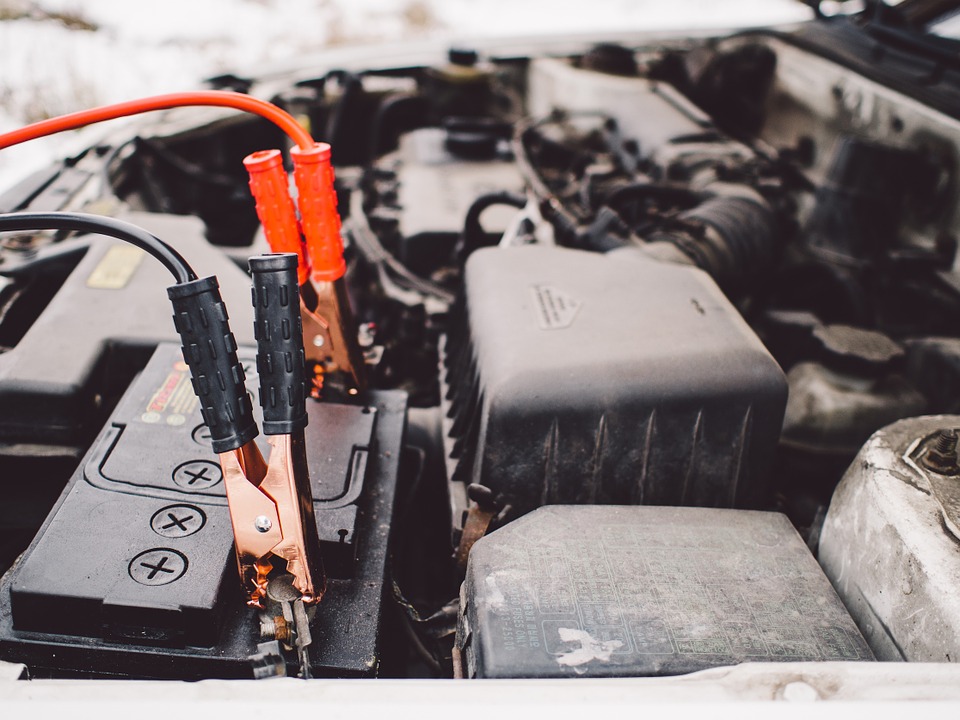
Step 1: Switch off both vehicles & ensure lights and other equipment is additionally killed. Open the car hood and evacuate any defensive caps over the battery terminals on the two vehicles. Leave the car killed until the point that you are done jump-starting the motorcycle and have disengaged the jumper links.
Step 2: Connect one red clamp to the positive terminal of the motorcycle battery. Ensure the clamp does not contact some other metal part. Associate the dark clamp to the motorcycle outline (attempt to pick a point free of paint or chrome to maintain a strategic distance from scratches or discoloration). It’s better not to associate straightforwardly to the negative terminal as this expands the possibility of harming the battery.
Step 3: Connect the other red clamp to the positive terminal of the car battery, ensuring the clamp contacts nothing else. Twofold watch that you are interfacing positively to positive. Next, associate the dark clamp to the negative terminal of the car battery, being careful not to contact the positive clamp simultaneously. Leave the car killed.
Step 4: Start the motorcycle. Except if the battery is completely gone, it should start up. Give it a chance to run a couple of minutes to warm up the motorcycle motor before detaching the jumper links.
Step 5: Disconnect the jumper links in the invert of the request you associated them (Stages 2 and 3). Be careful to shield the clamps from contacting anything metal until the point that the links are completely disengaged. Leave the motorcycle running until the point when you drive it home or to a bicycle shop to get another battery or an appropriate revive.
Important Tip:
Jump-starting a motorcycle from another motorcycle works a similar way, with one distinction.
- Before you start the bicycle with the dead battery, start the motorcycle with a decent battery. You leave a car killed to limit the odds the more powerful car battery will harm your motorcycle’s battery, yet this precaution isn’t essential for a bicycle to-bicycle jump start.
Should You Jump Start a Motorcycle Battery

There are numerous reasons why a motorcycle won’t start, so it bodes well to decide if the battery is the issue before endeavoring to jump start your bicycle.
- Ensure there is gas in your tank.
- Ensure the off button is off.
- Watch that your petcock is on. This primarily applies to more established, carbureted bicycles.
- Check your spark plugs. Wipe off any overabundance carbon develop, ensure they’re gapped effectively, and transform them out if necessary.
- Put your bicycle in neutral or potentially pull in the grasp. Have a go at starting your bicycle in neutral and with the grip pulled in. A few bicycles have a worked in wellbeing instrument to keep the rider from coincidentally starting the bicycle when it’s in gear.
- Put the kickstand up. This is another security system on a few bicycles.
Can I Jump a Motorcycle Battery With a Dead Battery?
Check Your Lights
- The battery marker will be on when there are any issues with the battery, similar to a broken connection or low voltage.
- On the off chance that your battery is depleted or dead, the headlights and backlight on the instrument board will probably be dimmer than common or may not work by any means.
Check Your Battery’s Voltage
On the off chance that the battery is totally dead (actually zero V), there’s no utilization attempting to jump start it, so check the voltage first.
- On the off chance that you have a voltmeter or multimeter, change the setting to DC, and place the leads on the positive and negative terminals of the battery.
- A decent voltage (V) perusing relies upon the span of your battery. For a 12-V battery, a full charge is 12.66 V, and 75% charge is 12.45 V. Anything underneath this will most likely be unable to start your motorcycle—particularly for the present day, fuel infused motorcycles.
On the off chance that you’ve verified that your battery is undercharged yet not absolutely dead, you can attempt to jump start it.
There are 3 different ways to start a motorcycle with a dead battery—with and without jumper links:
- Utilizing another motorcycle
- Utilizing a car battery
- Utilizing a portable battery jump starter
Way 1
How to Jumping a Motorcycle Battery Using Another Motorcycle Battery?
On the off chance that you’ve ever jump started a car, the procedure is the equivalent for motorcycles, in spite of the fact that accessing the battery terminals may be somewhat more troublesome. This requires you or the other rider have jumper links.
- Ensure the two Bicycles are off and in Neutral
- Discover the Battery Terminals
- For most bicycles, the battery is under the seat, yet this may vary contingent upon the make and model.
- In the event that the terminals on the battery are inaccessible, attempt the terminals on the chassis (where the battery links are darted onto the bicycle).
- Connect the Jumper Links
There is no particular order for interfacing jumper links, however, a great many people do it along these lines:
- Attach one positive clasp (red handles) to the positive terminal (more often than not has a red, rubber or plastic cover and named POS or +) of the dead battery.
- Attach the other positive clamp to the positive terminal of the great battery.
- Attach the negative clasp (black handles) to the negative terminal of the great battery.
- Attach the other negative clasp to an exposed metal surface (not painted or waxed) on the dead bicycle. This fair keeps any potential harm to the battery.
- Start the Working Bicycle
- Give it a chance to keep running for two or three minutes to ensure the battery is completely active.
- Attempt to Start Your Bicycle
- It might take a couple of endeavors. Check the connections, and ensure everything on your bicycle is set to run.
- When your bicycle starts, keep the two bicycles running for a couple of minutes to develop a charge.
- Detach the Jumper Links
- Start expelling the clasps in the turn around the order of how you put them on, starting with the negative clasp on your bicycle.
- Ride around for 15-30 minutes to revive the battery. In the event that you realize that your battery is en route out (i.e. not going to hold a charge that well), you don’t have to ride it around extremely far since you’ll simply be replacing it in any case.
Way 2
How to Jump a Motorcycle with a Car?
Utilizing a car battery to jump start a motorcycle isn’t commonplace or ideal, yet it can help get you home or to a workman when there’s no other option.
This should just be done if no other strategy is conceivable.
You will chance to harm the battery as well as the bicycle’s electrical framework since car batteries have a lot higher amperage (electrical flow quality) than a motorcycle battery. A lot of power might be conveyed too rapidly, overloading the battery and wearing out the starter. Hence, numerous batteries and motorcycle manufacturers will caution against utilizing a car battery to charge or jump a motorcycle battery, and doing as such may void guarantees.
By and by, on the off chance that you have to return home, this is the manner by which to securely do it:
- Ensure Both Your Motorcycle and the Car Are Off
- Associate the Jumper Links as You Typically Would
- Attach one positive clasp (red handles) to the positive terminal (more often than not has a red, rubber or plastic cover and named POS or +) of the dead battery.
- Attach the other positive clamp to the positive terminal of the great battery.
- Attach the negative clasp (black handles) to the negative terminal of the great battery.
- Attach the other negative clasp to an uncovered metal surface on the motorcycle.
- Have a go at Starting Your Motorcycle
- Keep the car off! Wrenching your bicycle likely won’t deplete the car battery, yet turning your bicycle with the car on will probably wear out your bicycle’s electrical framework.
- It should start up immediately. You may see that it turned more powerfully than expected.
- In the event that it doesn’t start immediately, hold up a couple of moments before attempting once more. Wrench it for close to 2 seconds on end. In the event that despite everything it doesn’t start, your battery may be totally depleted, or the issue probably won’t be the battery.
- Disengage the Jumper Links
- Evacuate the clasps in the turn around the order of how you put them on, starting with the negative clasp on your bicycle.
- Ride around for 15-30 mins, keeping the revs high to help charge the battery. In the event that you plan on replacing the battery, this isn’t fundamental.
Way 3
How to Use a Portable Jump Starter on a Motorcycle?
I would consider a portable jump starter battery pack a basic device to keep on your bicycle—particularly on solo rides, long separation rides, or excursions into remote territories. It will even prove to be useful at home, similar to when I couldn’t get the chance to work early in the day since I cleared out the lights on throughout the night.
Utilizing a battery pack is the fastest and most straightforward approach to get back out and about. You don’t have to rely upon any other person or hazard harming yourself endeavoring to push start your bicycle.
For best outcomes, you ought to counsel the manufacturer’s instructions that accompanied the jump starter, however here are the general advances:
- Start With Both Your Motorcycle and the Jump Starter Off
- Connect the Attached Links
- Jump starter packs ordinarily accompany a grouping of attachments, however, the most widely recognized ones are the natural clips seen on traditional jumper links.
- Interface the positive clip (red handle) to the positive terminal (named POS or +).
- Associate the negative clip (black handle) to an exposed metal surface on the bicycle or the negative terminal.
- On the off chance that the terminals on the battery are difficult to reach, take a stab at interfacing with the terminals on the chassis (where the battery associated with the bicycle).
- Turn the Jump Starter Pack On
- Some adaptable models may have various voltage settings for various batteries. Ensure the jump starter is set to the right voltage for your battery. For instance, in the event that you have a 12-V battery, it ought to be set to 12 V.
- Have a go at Starting Your Motorcycle
- Crank for close to 2-3 seconds on end. Portable jump starters are intended to convey short blasts of most extreme power, so cranking for quite a while will probably wear out the battery pack inside the jump starter.
- When the bicycle starts, evacuate the negative clip initially pursued by the positive clip.
- In the event that your bicycle doesn’t start up immediately, hold up a couple of minutes before attempting again to give the jump starter a chance to chill off and recuperate. In the event that it doesn’t start after a couple of endeavors, almost certainly, your battery won’t hold a charge or is totally dead.
- Separate the Jumper Links
- Start evacuating the clips in the turn around the order of how you put them on, starting with the negative clip on your bicycle.
- Ride around for 15-30 mins at high revs to help energize the battery. In the event that you plan on replacing the battery, this progression isn’t important.
- Energize the Jump Starter
- Cranking removes a ton of power from the battery pack. To ensure you are set up for future crises, charge your battery pack after each utilization.
Jump-starting is not a repair. You should discover what the real problem is so that you do not run into that problem again, or damage your motorcycle by driving it in suboptimal situations.
Disclaimer
“All brand names and images are Registered Trademarks of their respective companies. All manufacturers names, numbers, symbols and descriptions are used for reference purposes only, and it is not implied that any part listed is the product of these manufacturers or approved by any of these manufacturers.”


